

The short answer: 303 for machining, 304 for everything else
Both grades are 18-8-type austenitic stainless steels, roughly 18% chromium and 8% nickel. “18-8” is shorthand for that family, and 304 is its best-known member. 303 is essentially 304 with added sulfur. The sulfur makes it cut faster, and in exchange it gives up some corrosion resistance, weldability and formability.
So “which is better, stainless steel or 304?” is really a question about what the part must survive. Stainless is the family. 304 is the general-purpose default. 303 is the specialist for parts cut from bar and left as machined.
303 vs 304 stainless steel at a glance
| Property | 303 | 304 |
|---|---|---|
| Chemistry | 304-type base with added sulfur | No added sulfur |
| Machinability | Free-machining; short, breakable chips | Work-hardens; long, stringy chips |
| Corrosion resistance | Good in mild environments, lower than 304 | Better, especially against pitting |
| Welding | Generally not recommended (hot-cracking risk) | Good; 304L for heavy welds |
| Cold forming and bending | Poor; tends to crack | Good |
| Strength | Comparable | Comparable |
| Magnetic response | Non-magnetic when annealed | Non-magnetic when annealed |
| Typical parts | Screws, shafts, bushings, fittings, pins | Enclosures, tanks, welded assemblies, food equipment |
On strength, the published tensile strength and yield figures for the two grades differ only slightly. They also shift with temper and bar condition, so strength should not decide the grade.
Why 303 machines better
Sulfur forms manganese-sulfide inclusions in the steel. These act as built-in chip breakers, so 303 produces short chips that clear the cut. 304 work-hardens quickly and throws long, stringy chips that wrap the tool and build up on the cutting edge.
Under the standard AISI machinability index, 303 rates at roughly 75–80% of free-machining B1112 steel, while 304 sits near 45%. In practice that means less built-up edge, longer tool life, faster cycle times and a cleaner surface finish on lathe work. Machining time is usually the biggest cost driver on turned parts, so the grade choice shows up directly in the price per part.
Rare variants such as 303Se (selenium) and 303Cu exist. Standard 303 covers almost every request. See our stainless steel turned parts for what we make from it.
Where 304 wins: corrosion, welding and forming
Corrosion. The inclusions that break chips also give pitting a place to start. In salt spray, chlorides or frequent wash-down, 303 is the weaker choice. A good passivation of stainless steel after machining removes embedded iron and restores the surface on either grade, but it does not make 303 behave like 304.
Welding. 303 is prone to hot cracking, so welding it is generally not recommended. For welded assemblies use 304, or 304L when welds are heavy.
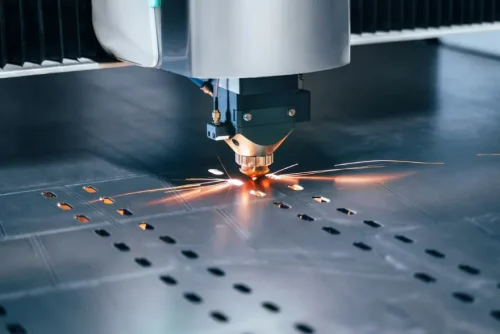
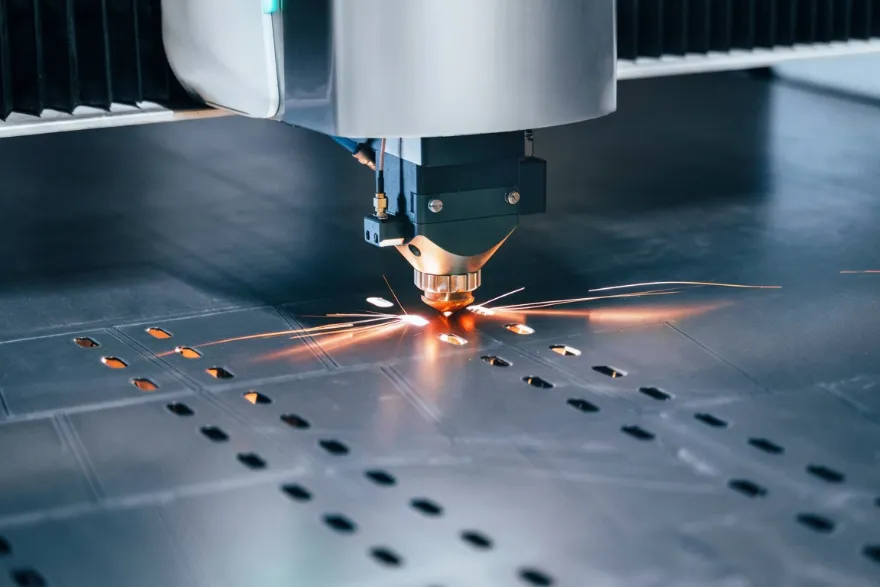
Forming. 304 bends and draws well. 303 tends to crack when formed, which is why it is mostly supplied as bar. Sheet and plate for cut-and-bent parts are typically 304 or 316L; the laser cutting thickness guide for stainless, aluminium and copper shows how those grades behave on the bed, and our steel laser cutting page covers the process.
How to choose among stainless steel grades: a simple decision rule
Choose 303 when all of these hold:
- The part is machined from bar.
- It will not be welded, bent or drawn after machining.
- It will not see chlorides or harsh wash-down.
- Cycle time and cost matter. Typical examples are screws, shafts, bushings, pins and fittings.
Choose 304 when any of these apply:
- The part will be welded, bent or drawn.
- It goes into food, outdoor or marine-adjacent service.
- Corrosion is the likely failure mode.
Move to 316/316L when chlorides, salt or aggressive chemicals are present.
When in doubt on a corrosion-critical part, go 304. And never let a supplier swap 303 for 304 without approval: a part that looks identical can crack at a weld or pit in service months later.
Where 316 fits, and how to tell 303 from 316
316 is 304 with about 2–3% molybdenum added, which is what gives it its resistance to chlorides. In a 316 vs 304 stainless steel decision, 316 wins wherever salt or chemicals are present, and 304 wins on cost where they are not. In a 303 vs 304 vs 316 comparison, 303 sits at the machinability end and 316 at the corrosion end. For food-contact parts, 304 or 316 is the usual choice, not 303.
You cannot reliably tell 303 from 316 by eye, weight or magnet. The dependable ways are the mill certificate and heat number, or PMI/XRF testing, which detects the molybdenum that marks 316. While cutting, short, easily broken chips also point to 303. We check incoming material against the mill certificate and heat number, and ship a material certificate with each lot.
Specifying the grade on your drawing
Write the grade and its material standard in the title block, for example “303 stainless steel, bar, annealed” or “304 stainless steel, bar”, rather than “stainless”. Add “mill certificate required” and “no material substitution without written approval.” Stainless options on our turned and milled parts include 303, 304, 316L and 17-4PH.
Unsure which grade fits? Send a STEP or IGES file with a 2D drawing through Contact Us. We review the part and confirm the grade, with a response within one business day.
FAQ
Which is better, stainless steel or 304 stainless steel?
304 is a grade of stainless steel, so the real question is which grade suits the part. 304 is the general-purpose choice for corrosion resistance and fabrication, 303 is better for machined parts that will not be welded, and 316 is better in chlorides.
Will a magnet stick to 304 stainless steel?
Not normally, because annealed 304 is non-magnetic. Cold working such as bending or heavy machining can make it weakly magnetic, so a slight pull does not rule out 304. A magnet cannot confirm the grade either way.
How to tell the difference between 303 and 316 stainless steel?
Sight, weight and magnets are unreliable. Check the mill certificate and heat number, or use XRF/PMI testing to look for molybdenum, which is present in 316. Short, easily broken chips during cutting also point to 303.
Is 303 stainless steel rust resistant?
Yes, in mild environments, but it resists corrosion less well than 304 because of its sulfur content. For salt, chlorides or harsh wash-down, choose 304 or 316 instead.
Ready to put a grade on a drawing? Request a quote with your files and quantities.