

Choose a Swiss-type lathe when the part is small in diameter, slender and carries several features such as cross holes, flats and threads, especially when it repeats. Choose a conventional CNC lathe when the part is larger in diameter, short and stocky, or needed in small quantities with few features.
A Swiss machine is itself a CNC lathe, one with a sliding headstock and a guide bushing. The decision is between two turning set-ups, not two different trades. Diameter, length-to-diameter ratio, feature count, volume and tolerance decide it, and the checks below take them in order. Divine Precision runs Swiss turning and CNC twin-spindle turn/mill machines, so the recommendation follows the part rather than the machine.
Swiss lathe vs CNC lathe at a glance
The table compares a Swiss CNC lathe with a conventional turning centre on the points that change a quote.
| Factor | Swiss-type lathe | Conventional CNC lathe |
|---|---|---|
| Workholding | Bar slides through a guide bushing, so the tool cuts right beside the support | Chuck or collet grips the blank; tailstock or steady rest for long work |
| Typical diameter | Small; typically under about 32 mm | Wider band, including larger blanks and billet |
| Slender parts | Stable, because support next to the cut limits deflection and chatter | Overhang flexes unless the part is short or supported |
| Live tooling and back-working | Usually live tools plus a sub-spindle: cross holes, flats and threads in one cycle | Live tooling on turn/mill models; twin-spindle machines add back-working; otherwise separate operations |
| Setup and volume fit | More programming and setup; pays back on repeating parts | Quicker to set up on simple parts; suits prototypes and short runs |
| Machine cost and rate | Higher machine cost, which feeds into the machine rate | Lower for a comparable size |
In practice, three Swiss traits tend to arrive together: live tooling, a sub-spindle and a small maximum bar diameter. If a part needs the first two, it usually has to fit the third. That is why diameter is the first check below.
How each machine holds the part, and why it matters
Swiss-type: sliding headstock and guide bushing
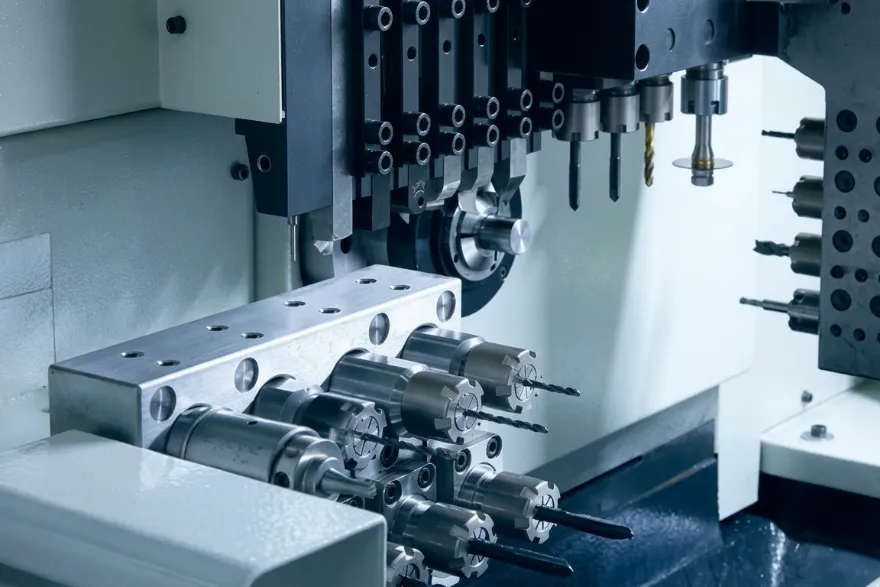
In Swiss turning, the headstock slides the bar forward through a guide bushing, and the tool cuts only a few millimetres from that support point. A thin pin or long, narrow shaft therefore has little free length to bend under tool pressure. Bar feed and part-off are continuous, which suits unattended runs on repeating parts.
Conventional CNC lathe: chuck, tailstock and where it wins
A chuck grips the blank at one end, and a tailstock or steady rest supports the other when needed. That arrangement is rigid for larger or shorter parts and tolerates heavier cuts. Billet and bigger-diameter blanks are natural work for it. Slender work is where it struggles, because the unsupported length can flex.
Twin-spindle turn/mill machines narrow the feature gap on larger diameters. A second spindle picks up the part for back-side work, and live tools handle milled details. They do not turn a thin, long part into one the guide bushing would have supported.
Five checks on your drawing that decide it
Run your print through these in order. Each check ends with a verdict, and most parts are settled by the second or third.
1. Diameter
Our turned range starts at 3 mm, and the smallest bars lean clearly Swiss. Swiss-type machines typically work under about 32 mm. Above that, the choice moves to a conventional lathe or a turn/mill. If the largest outside diameter on the print is well beyond that band, the part is a conventional-lathe job whatever its other features.
2. Length-to-diameter ratio
As a rule of thumb, a length-to-diameter ratio above roughly 3:1 favours Swiss, and a ratio under 2:1 favours a chuck. Between 2:1 and 3:1, let diameter and feature count decide.
Above 3:1, support at the cut stops the bar bending away from the tool. That bending shows up as taper, chatter marks and out-of-round sections. Under 2:1 the part is stubby enough that a conventional chuck holds it just as firmly, and the guide bushing adds little. A 6 mm pin that is 30 mm long (5:1) belongs on a Swiss machine. A 25 mm flanged body that is 30 mm long (about 1.2:1) does not.
3. Feature count and operations
Count what happens after the basic diameter is turned: cross holes, flats, knurling, grooves, threads and laser marking. Several of these on one part favour Swiss, where live tooling and the sub-spindle finish both ends in one cycle. One cycle also keeps turned and milled features concentric to each other, since the part is never re-gripped. A part with only a diameter, a face and a thread usually does not justify that route.
4. Volume
Repeating runs spread the Swiss setup and programming over many parts, and bar-fed operation keeps the machine cutting between loads. Prototypes and one-offs depend on the geometry and on which machine is free. We accept a 1-piece MOQ, with run sizes from one piece to 100k+. A complex slender prototype may still belong on a Swiss machine, while a simple medium-volume part may run better on a conventional lathe with existing tooling. Volume tips a close call but rarely overrides diameter or L/D.
5. Tolerance and finish
Tolerance does not pick the machine on its own. Both set-ups can hold tight diameters, and what is achievable depends on the part, the material, the tooling and how it is inspected. For our turned parts the diameter tolerance is ±0.01 mm as turned and ±0.005 mm ground. Surface finish is Ra 1.6 µm as standard, with Ra 0.4 µm on request. A ±0.005 mm callout therefore often means turning followed by grinding, whichever lathe does the turning. Machining tolerances explains how to set realistic callouts per feature.
Finish also changes size. Plating and anodizing add coating build-up on critical diameters, so the drawing should say whether the tolerance applies before or after coating. Type II versus hard anodize sets out how the two coatings differ in how they treat a tight bore or thread, and when to specify each anodize type helps with wording the callout on the print.
If the print clears these checks and you want a second opinion, send it with quantity and material and we will name the process in the reply.
What drives cost per part
Machine type matters less to the quote than the time and handling a part consumes. The main drivers are:
- Cycle time: every operation the machine performs in one cycle is one fewer elsewhere.
- Setup and changeover: tooling, program proving and first-article approval are spread across the run.
- Bar-feed automation: a bar-fed machine can run continuously between loads.
- Machine hourly rate: Swiss-type machines generally cost more than conventional lathes of similar size, and the rate reflects it.
- Scrap and part-off waste: more rejects, or more material lost per part, raise the cost.
- Secondary operations and finishing: each extra handling step adds time, and coatings add their own cost.
Swiss costs more per part when:
- The part is short and simple and gains nothing from bushing support.
- Quantities are small enough that setup dominates.
- Only one or two features are needed after turning.
Swiss costs less per part when:
- One setup replaces turning, cross drilling, flatting and back-end work done elsewhere.
- The run repeats and a bar-fed cell can run it unattended.
- Slender geometry would otherwise cause scrap or extra inspection on a chuck lathe.
Worked example: a small fitting with cross holes
Take a 6 mm stainless fitting, 30 mm long (5:1), with a turned diameter, a bore, a thread, a back-end chamfer, one cross hole and two flats. That is eight operations: turn the outside, face, drill the bore, cut the thread, chamfer the back end, drill the cross hole, mill the two flats, and part off.
- On a Swiss machine: one setup. The guide bushing supports the thin bar, live tools drill the cross hole and mill the flats, and the sub-spindle takes the part for the back end before part-off.
- On a chuck lathe: three setups. The first turns, bores and threads one end. The part is then re-gripped for the back end. A third setup on a milling machine drills the cross hole and cuts the flats. Each re-grip adds handling and a chance for concentricity to drift, and the 5:1 length can flex during the first cut.
The cost direction depends on quantity. For a repeating run, the Swiss route usually comes out lower per part, because one cycle replaces three setups and a bar feeder keeps it running. For a handful of pieces, the Swiss programming and setup can outweigh that saving, and the chuck route may cost less even with the extra handling. The same part with no cross hole and no flats would drop to four operations on a single chuck setup, and the case for Swiss would mostly disappear.
Machine purchase price matters less to a part buyer than cost per part. Cost per part is set by the drawing, the quantity, the material and the finish, and we quote it from the print.
When a conventional CNC lathe is the better call
A conventional lathe is the better call in these cases:
- Larger diameters, or blanks that are not bar stock.
- Short, heavy or stocky parts such as flanged bodies, spacers and collars.
- Low quantities with a modest feature list.
- Parts that need a single simple pass and no secondary operations.
- Billet work that sits outside what a bushing can feed.
CNC turned parts such as shafts, bushings and bodies are typical examples, and carbon steel turned parts cover the free-cutting and alloy steel end of that family. A twin-spindle turn/mill is the middle path when a larger part also needs milled features and back-end work. We do not treat it as an equivalent to a Swiss machine on slender parts.
The downsides of a conventional lathe each trace back to a drawing trigger:
- Flex on slender parts: an L/D above roughly 3:1 on the print is the warning.
- Extra setups: several features on different faces mean re-gripping, which can disturb concentricity.
- Added secondary operations: cross holes, flats or milled details done on another machine add handling and lead time.
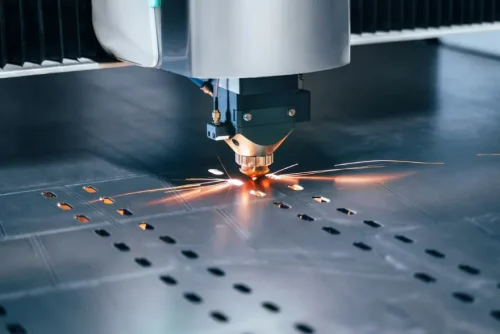
Some parts are not turned at all. A flat plate or profile belongs with laser cutting, and the laser cutting thickness guide shows what stainless, aluminium and copper sheet allow. A prismatic block with pockets and drilled faces is CNC milling work.
Quick examples: which process for which part
These sketches are illustrative; your print has the final say.
| Part sketch | Likely process | Why |
|---|---|---|
| Slender pin, high L/D, small diameter | Swiss-type | Guide bushing holds the bar beside the cut, so it does not bend |
| Short flanged body, larger diameter | Conventional CNC lathe | Stocky and rigid; the bushing adds nothing |
| Small fitting with cross holes and a thread | Swiss-type | Live tooling and sub-spindle finish it in one cycle |
| Larger billet part with a bore and a groove | Conventional CNC lathe (or turn/mill) | Diameter outside typical Swiss range |
| Flat bracket or pocketed block | Neither: laser cutting or milling | The part is not a turned shape |
Send us the drawing and we’ll pick the process
We run Japanese- and German-made Swiss automatic screw machines alongside CNC twin-spindle turn/mill machines. We have no reason to push a part onto the wrong platform, and routing is set by the five checks above.
Send a STEP or IGES model plus a 2D drawing with GD&T, together with the quantity, material and finish. Mark the critical diameters and say whether tolerances apply before or after coating. An NDA is available on request, before quoting or ordering. Replies come within one business day through the contact form, where you can upload files securely. Small steel parts leave protected with VCI film and anti-rust oil, as set out in packing machined parts for sea freight.
FAQ
What makes a Swiss lathe different?
A sliding headstock feeds the bar through a guide bushing, so the tool cuts right beside the support point. Swiss-type machines usually add live tooling and a sub-spindle, which suits small, slender parts with several features.
Is Swiss turning more accurate than CNC turning?
Often on slender small parts, because the support limits deflection at the cut. Accuracy also depends on material, tooling, the feature in question and how it is measured, so the tolerance is judged per drawing rather than by process alone.
Do I need a Swiss lathe for small parts?
Only if diameter, L/D or feature count calls for it. A short, small part with few features can run well on a conventional lathe, and a Swiss set-up would add cost without adding accuracy.
What are the downsides of using a CNC lathe?
Slender parts can flex under tool pressure. Complex parts may need more than one setup, and secondary operations add handling. Which of these applies depends on the part’s L/D and feature list.
Is Swiss machining more expensive?
The machine rate is generally higher, but the part price depends on cycle time and setup. When one Swiss cycle replaces several separate operations, the part can cost less. For a short, simple part it often costs more.
Who makes Swiss CNC machines?
Japanese builders such as Citizen, Star, Tsugami and Nomura make them, and so does Tornos in Switzerland, among others. For a buyer, the shop’s process control, inspection and traceability matter more than the machine badge.
Swiss lathe vs Swiss CNC milling machine?
A Swiss-type machine is a turning machine. Live tools handle secondary milling such as flats and cross holes, but heavy milling of prismatic parts belongs on a machining centre.